Attending the World Fantasy Convention

A couple of weekends ago I was fortunate to attend the World Fantasy Convention in Brighton, UK which is an hour or so’s train ride from where I live. A fine time was had! Although I’ve got two World SF Conventions under my belt (Dublin in 2019 and Glasgow in 2024), this was my first World Fantasy Con. It was very cool with lots of great guests in attendance, and had the advantage of not being too crowded, yet well-attended. (And also superbly run by the organisers).

There was a great mix of panels and events, and a chance to catch up with some friends I hadn’t seen for a while. The convention hotel was very spacious and accommodating, with a good mix of rooms catering to different audience capacities, laid out across multiple floors – and connected by suitably maze-like corridors, connecting doors and ‘secret’ entrances. (There were rumours that the people we passed in the corridors who looked particularly harried were guests from the 2013 World Fantasy Con still trying to find their way out – but might just have been late night revellers).

One of my personal highlights was getting to chat with author (and editor!) James Logan after a panel he was part of. He was full of sage advice and general publishing wisdom. He very kindly signed a copy of his fantasy novel The Silverblood Promise which I started reading back in my hotel room, and I have to say it is a most excellent book. The second in the series (The Blackfire Blade) has just been published and it’s going straight on my TBR list.

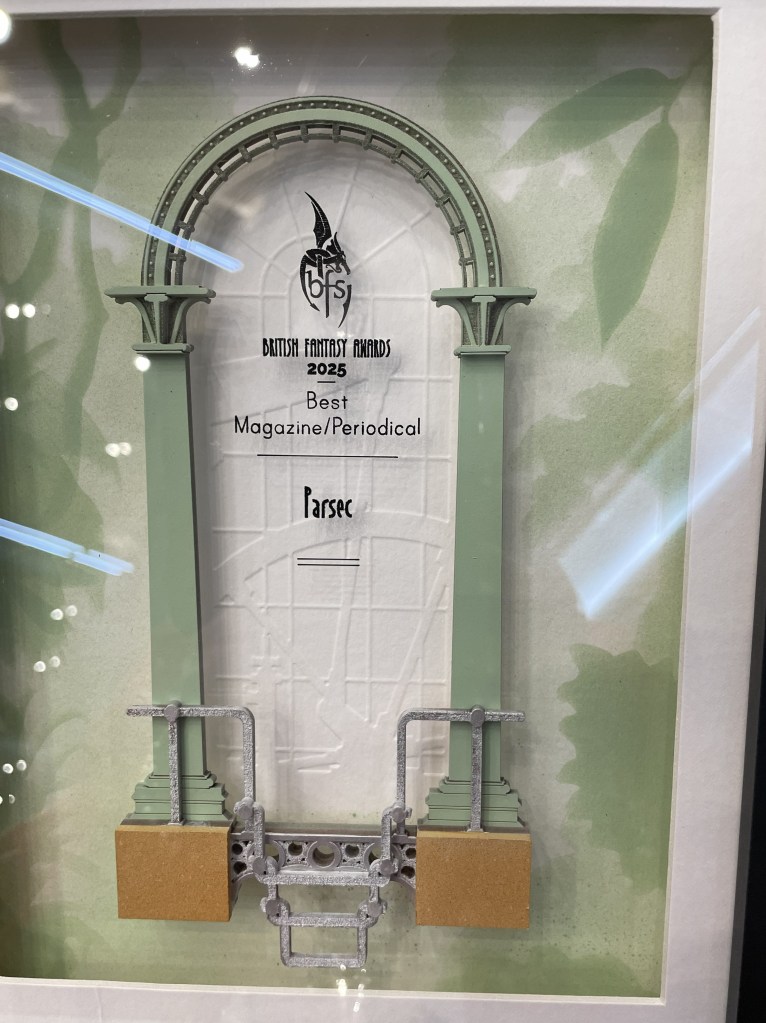
Another highlight was seeing science fiction magazine ParSec win the 2025 British Fantasy Award for Best Magazine/Periodical. ParSec is a great SF/F magazine edited by the incomparable Ian Whates and I don’t think it gets enough mention. Obviously I am a little biased, having published my story Pennies in the Meme Jar back in ParSec issue 8, but the quality has always been very high, and in an era where high-quality SF/F outputs seem to be disappearing, ParSec has an important role to play. Let’s hope the BFA win brings in new readers and new subscriptions. (Subscriptions are available here).

One other thing that took my fancy was just along the sea front from the convention hotel. Brighton has a panoramic viewing tower called i360 which has a large viewing capsule that ascends a tall concrete pillar. Even though I’m not a great lover of heights, I quite fancied having a trip up – but alas, whenever I had free time away from the convention, the weather conditions weren’t right. (Brighton at the end of October is windy!). But I could see it from my hotel window and even in the middle of the night the capsule seemed to roost two thirds of the way up the tower. What I particularly liked was that if you got up close and tilted your head just so, without quite taking in the top of the column, it was possible to imagine it as an orbital tower with the capsule transporting passengers up to geostationary orbit.

The Astounding Analog Companion

The very wonderful Analog Science Fiction & Fact magazine has a section of its website called ‘The Astounding Analog Companion.’ Here you can find a vast archive of short pieces written by Analog authors going back many years. (The archive, not the authors – although both may be true in my case). These are an eclectic mix of essays on science fictional subjects. I wrote one back in August 2022 called ‘The Humble Book Reimagined.’

Sometimes the essays explore a particular theme or idea in a published story. For instance, I’ve just enjoyed Sean McMullen’s thought piece on building a planet-sized space telescope, an idea which is the centrepiece to his story “Mirrorstar” in the Nov/Dec 2024 issue of Analog which I enjoyed very much.

Anyway, to coincide with the publication of my own novelette ‘The Touchstone of Ouroboros’ in the Nov/Dec 2024 issue, you can find my musings on this piece’s origin story, called (unsurprisingly) ‘Origin Stories’ up on the site which is free to read. Here’s the odd thing. At no point in ‘The Touchstone of Ouroboros’ do any rats feature. Not a single one. Yet I can trace the origin of this story back more than ten years to something that involved a LOT of rats! A whole man-sized ball of rats, in fact.

If you’re curious, please buy a copy of Analog and read ‘The Touchstone of Ouroboros’. Then read ‘Origin Stories’ and all will become clear. Let me know what you think!

BSFA Award Winners

Many congratulations to all the winners of 2023 BSFA awards which were announced at last weekend’s Eastercon in Telford, UK.

The full list of winners in all categories can be found here, courtesy of Locus magazine.

It felt like a very strong shortlist across all the categories and I’m looking forward to catching up on some gems on the shortlist I might otherwise have missed.

Amongst the deserving winners, I was particularly pleased to see Best of British Science Fiction 2022 (edited by Donna Scott) take first place in the Best Collection category. These anthologies have long been a favourite of mine, showcasing British science fiction talent – and of course I was thrilled to be included in the previous year’s volume with my story How Does My Garden Grow? Many, many congratulations to Donna Scott for getting much deserved recognition for her editing, and to Ian Whates and the whole publishing team at Newcon Press.

Full shortlist and winners:

Best Novel

  • WINNER: The Green Man’s Quarry, Juliet E. McKenna (Wizard Tower)
  • Descendant Machine, Gareth L. Powell (Titan)
  • Airside, Christopher Priest (Gollancz)
  • HIM, Geoff Ryman (Angry Robot)
  • Shigidi and the Brass Head of Obalufon, Wole Talabi (Gollancz)

Best Shorter Fiction (for novelettes and novellas)

  • WINNER: And Put Away Childish Things, Adrian Tchaikovsky (Rebellion)
  • Broken Paradise, Eugen Bacon (Luna)
  • I Am AI, Ai Jiang (Shortwave)
  • Europa, Allen Stroud (Flame Tree)
  • “Knotted Thorn”, Kari Sperring (The Book of Gaheris)

Best Short Fiction

  • WINNER: “How to Raise a Kraken in Your Bathtub”, P. Djèlí Clark (Uncanny 1-2/23)
  • “Copper”, Jendia Gammon (Interzone 295)
  • “The Spoil Heap”, Fiona Moore (Clarkesworld 3/23)
  • “Lady Koi Koi: A Book Report”, Suyi Davies Okungbowa (Apex 6/20/23)
  • “A Little Seasoning”, Neil Williamson (Interzone Digital)

Best Collection (for collections and anthologies)

  • WINNER: The Best of British Science Fiction 2022, Donna Scott, ed. (Newcon)
  • Strange Attractors, Jaine Fenn (Newcon)
  • No One Will Come Back for Us, Premee Mohamed (Undertow)
  • Mothersound: The Sauútiverse Anthology, Wole Talabi, ed. (Android)
  • Best of World SF: Volume 3, Lavie Tidhar, ed. (Bloomsbury)

Best Fiction for Young Readers

  • WINNER: The Library of Broken Worlds, Alaya Dawn Johnson (Harpercollins)
  • The Inn at the Amethyst Lantern, J. Dianne Dotson (Android)
  • A Song of Salvation, Alechia Dow (Inkyard)
  • Mindbreaker, Kate Dylan (Hodder & Stoughton)
  • We Who Are Forged in Fire, Kate Murray (Hardie Grant)

Best Non-Fiction (Long)

  • WINNER: A Traveller in Time: The Critical Practice of Maureen Kincaid Speller, Nina Allan, ed. (Luna)
  • Spec Fic for Newbies: A Beginner’s Guide to Writing Subgenres of Science Fiction, Fantasy, and Horror, Tiffani Angus & Val Nolan (Luna)
  • All These Worlds, Niall Harrison (Briardene)
  • Ex Marginalia: Essays on Writing Speculative Fiction by Persons of Color, Chinelo Onwualu, ed. (Hydra House)
  • “The Female Man”, Farah Mendlesohn (Eastercon talk)

Best Non-Fiction (Short)

  • WINNER: “Project Management Lessons from Rogue One”, Fiona Moore (adoctorofmanythings.wordpress.com)
  • “Dominant Themes in Afro-Centric Fiction”, Eugen Bacon (Aurealis 158)
  • “Weaving the Rainbow: Worldbuilding and SF”, Gautam Bhatia (Bombay Literary Magazine 4/23)
  • “Exposition Tax: The hidden burden of writing from the margins”, Suyi Davies Okungbowa (Ex Marginalia)
  • “Tech Billionaires Need to Stop Trying to Make the Science Fiction They Grew Up on Real”, Charles Stross (Scientific American 12/20/23)
  • “Prisoners in the Temple of the Muses”, Wole Talabi (Ancillary Review of Books 8/17/23)

Best Translated Short Fiction

  • WINNER: “Vanishing Tracks in the Sand”, Jana Bianchi, translated by Rachael Amoruso (The Bright Mirror)
  • “Bacterial”, Marcelo Cohen, translated by Kit Maude (Samovar 10/23/23)
  • “Retreat from the World Outside”, Gabriela Damian Miravete, translated by Adrian Demopulos (They Will Dream in the Garden)
  • “The Unknown Painter”, Henry Lion Oldie, translated by Alex Shvartsman, (Future SF 1/23/23)
  • “A Pilgrimage to Memories Tattooed”, Elena Pavlova, translated by Elena Pavlova & Desislava Sivilova (Samovar 6/26/23)
  • “My Guy”, Izumi Suzuki, translated by Sam Bett (Hit Parade of Tears)

Best Artwork

  • WINNER: Leo Nickolls for the cover of The Surviving Sky by Krikita H. Rao (Titan)
  • Elena Betti for the cover of Danged Black Thing by Eugen Bacon (Apex)
  • Christine Kim for the cover of Jewel Box: Stories by E. Lily Yu (Erewhon)
  • Julia Lloyd for the cover of Descendent Machine by Gareth L. Powell (Titan)
  • Juliana Pinho for the cover of “The Alphabet of Pinaa: An AI Reinvents Zerself on an Inhabited Moon” by Eugen Bacon (Interzone Digital)
  • Vinayak Varma for illustrations for “Strung Along in Seaforth” by Jonathan Laidlow (Interzone 295)

Best Audio Fiction

  • WINNER: The Dex Legacy, Emily Inkpen (www.thedexlagacy.com)
  • “When a Portal Comes Around”, Rick Danforth (Upbeat Tales 9/23)
  • “Carlos Explained”, Joseph Fink & Jeffrey Cranor (Welcome to Night Vale 7/14/23)
  • Simultaneous Times Podcast, Episode 67, Jenna Hanchey & Abigail Guerrero (Space Cowboy)
  • “The Pigeon”, Michelle Knudsen (Drabblecast 7/21/23)

Analog blog-post and a Q&A with me!

So alongside my story “Where the Buffalo Cars Roam” about make-do-and-mend survival in a post-apocalypse world where a few autonomous vehicles still run wild – you have read it, right? – the Analog blog site (aka the Astounding Analog Companion) have very kindly published a blog I wrote and a Q&A session with me.

The blog-post revisits the thorny old debate about which is better: physical books or e-books? Of course, what’s best for an individual partly depends on what you’re hoping to gain from the reading experience, your circumstances and surroundings, and in no small part, personal preference. There is no right or wrong answer – but I had fun looking at some of the pros and cons and exploring my own feelings on the matter.

The Q&A explores the many influences (science fictional and otherwise) on my reading down through the years, my author heroes and some of the things which triggered the writing of “Where the Buffalo Cars Roam.” It was a fun exercise answering Analog’s questions and I’m absolutely thrilled to be featured on the Analog Companion website. Who would ever have thought it!

You can check them both out here:

Places to write

Like many writers, I’ve done my time in coffee-shops, and I can make it work if I need to, but most of my writing gets done at home, sitting at a desk in my own little space. Which is fine. It’s convenient, I can shut the door and focus, and I don’t need to buy over-priced coffee to do it. But sometimes I do feel it’s nice to shake things up a bit and a change of (non-distracting) background can be energising.

Libraries (obviously) are a wonderful alternative. I used to frequent the Guildhall Library in London during my lunch hour. I also tried writing in the main space of the British Museum (usually crowded, no guarantee of space to sit) or outside on a bench (usually wet or cold!)

Driving somewhere remote but scenic and working in the car is another perennial favourite, but rarely executed. I don’t travel much, so can’t really say I work on planes or in hotel lobbies as I’m usually too caught up in the novelty of the experience.

For a few years, I got an hour’s writing done on the train travelling to work every day. (But not on the way home because I was invariably in a brain-dead state by then and only fit for dozing). At first, I felt incredibly self-conscious. Plenty of other commuters had their laptops out but they had spreadsheets open, or poked at what were obviously work-related documents, or just noodled away at their email. I, on the other hand, might be describing the scintillation of energy bolts in some space battle far beyond Earth’s orbit or plotting the subjugation of humanity by our AI overlords. I could never be sure what others on the 7.10 to Waterloo would make of it if they shoulder-surfed my screen.

So I bought myself a screen filter that made shoulder-surfing difficult and worked in a light grey font that was microscopically small – so that even I struggled to read my words.

Gradually things changed, or at least, my attitude changed. When some of those stories began to get published and I even won an award or two, the inhibitions dropped away. No stranger has ever actually approached me and said, “Excuse me but are you writer?” but I rather like the idea that they might.

A little while ago my wife bought my one of those notebooks with “Careful – or you might end up in my next novel,” inscribed on the cover in bold letters. I don’t flaunt it, but I don’t hide it away either if I’m out and about. (And it’s a lovely thing to write in). I’m still hoping for the day when someone (probably another writer) says, “Oh, are you a writer then?” and I can smile and say self-deprecatingly, “Why yes. As it happens, I do scribble now and then.”

But it hasn’t happened yet.