New story today – ParSec 8

I’m delighted to announce the latest issue of ParSec SF/F magazine has been published today and is available to buy from PS Publishing’s website here. Issue 8 includes my story “Pennies in the Meme Jar” – a near future tale where our protagonist both discovers and then loses herself within the illicit world of addictive meme-strips. It was a lot of fun to write and I hope readers will enjoy it too.

I was lucky enough to see an early proof copy of the full magazine. I can therefore confirm there’s some cracking fiction in this issue from a bunch of very talented authors. (The same can be said of previous issues). ParSec hasn’t being going that long but under the skilful editorship of Ian Whates it’s already building a strong reputation for high quality science fiction and fantasy. For example, Neil Williamson’s story from ParSec 4 “A Moment of Zugzwang” was a BSFA award finalist this year.

If you haven’t done so already, it’s well worth checking ParSec out.

Forward the Foundation!

*** No spoilers in what follows – promise! ***

I very much enjoyed Season 1 of Foundation, the adaption of Isaac Asimov’s classic trilogy (and later, a series) of novels when it aired on AppleTV in 2021. (It was the main reason I took out a subscription). I’m enjoying Season 2 as much, if not more, now that I feel truly at home in this re-imagined universe.

I came to it with some trepidation. However I learnt a long while ago that you’re kidding no one but yourself expecting a film or television adaptation of any novel to align with what you remember (and enjoyed) from reading the book. With very few notable exceptions, strictly faithful reinterpretations of a novel usually fall flat. That should come as no great surprise because the reading experience and the visual experience are two quite separate things.

I remember some years back hearing someone complain that the TV adaptation of Stephen King’s Under the Dome had altered the plot line, introduced different characters and generally messed around with some core elements in the much beloved novel. Stephen King replied saying it was great how much that reader/viewer cherished the book version and a shame they hadn’t got into the TV series. But the good news was: the novel was still there! The book could be read any time you liked – and he could guarantee that no one would ever mess with its plot or characters or structure.

And I think that’s the key. Foundation the TV series is very different to the novels. They share some concepts and perhaps a broadly similar story arc (time will tell!) and many of the character names are retained – but that’s as far as it goes. This has allowed the show runners to do a quite brilliant job in reimagining the story whilst still playing in that universe. (I particularly like the reimagining of Empire and I’ve found the storylines featuring those characters really compelling). It’s not what Asimov wrote but it is adjacent to it (and pays homage to the big ideas) – and the TV series is all the stronger for it.

With that in mind, I’ve recently gone back for a re-read of Isaac Asimov’s original trilogy. I’m finding I can enjoy both the novels and the TV series simultaneously, appreciating the similarities and the nuanced differences. I’ve dug out a very old three-in-one volume I stumbled across in a used bookshop some years ago. I’m not sure if this is a first edition of the combined trilogy but it might well be. The copyright date inside is 1951 but it seems to predate the publishing practice of printing a publication date or print run information. Either way, I love the feel of those thick, rough-cut pages and who doesn’t love the smell of an old book. Ah…!

New(ish) fiction announcement

I somehow managed not to put up a blog post when my story “To Love and Drive in L.A” was published in IZ Digital, although I did tweet about it. Well, now I’m putting that right.

The story is set in Los Angeles (you mean you didn’t guess?) and I’ve been fortunate to visit there twice, although those visits were several decades apart. Several of the locales that feature in the story were based on remembered places I had visited and then later researched with the aid of Google Maps. So I had a clear mental image to work from when I was writing the story.

I was fortunate that Gareth Jelley, editor and publisher of both Interzone and IZ Digital took the story. I was even more pleased when I saw the cover image Gareth had lined up to accompany my piece which perfectly fit with how I pictured the landscape in my imagination. Gareth is wonderful to work with and it’s great to see him continuing to take Interzone to new audiences.

Although the story was published a couple of months ago, it’s still available to purchase on the IZ Digital site here.

––It’s just another job for one of the taxis in the city’s fleet of autonomous vehicles. You see them everywhere, and they’ll take you anywhere you want to go. But late at night when the rides are scarce, have you ever wondered what they might get up to?

“There’s nothing to be afraid of. What harm can I do? What threat do I represent? I’m an autonomous vehicle. My purpose is limited and dictated by function.”

Switching my SF magazine subscriptions

Prompted by an email from Amazon, I’m reminded that the Kindle September deadline is fast approaching and it’s time to get my SF magazine subscriptions sorted and seek out new vendors.

As many people know, Amazon announced last year it would stop providing monthly subscriptions for most (all?) magazines previously available via the Kindle store. The availability of new subscriptions ended some time ago I believe, but customers with existing magazine subscriptions have until September this year to find other places to fulfil their e-subscriptions. This is when Amazon finally turn out the lights on this section of its Kindle store.

The Kindle magazine subscription service has mostly worked well for me over the past decade. I’ve found it convenient, reliable and cheap, although I came to it with some trepidation. Initially, I was reluctant to trade my paper copies of publications such as Asimov’s Science Fiction and Analog for electronic versions. But distribution to the UK was becoming increasingly erratic with long delays and numerous missing or damaged issues. Add to that pricing considerations (the ePub version could be as much as a half to a third the price of the paper copy once overseas postage was included) and it made sense to switch. Neverthless I did so with considerable reluctance. Until then I had an unbroken run of Asimov’s, right from the very first issue, and a decade or two of Analog and F & SF. It still pains me that my collection had to end—or at least transition to ebook versions.

I imagine the widespread availability of SF and fantasy magazines on the Kindle store was welcomed by their publishers who were seeing physical magazine sales slowly decline. I know that guaranteed income from subscribers makes a big difference to small press publishers operating on a shoestring. Subscriptions—even ones where Amazon takes a hefty slice of the purchase price—is really important for a publication’s financial stability.

All that is gone now, of course. I’ve read that many (if not all) of the well known SF magazines face considerable uncertainty as a large slice of subscriber revenue is chopped. No one knows how many subscribers will bother finding alternative outlets and taking out new subscriptions. I hope they do––but it seems inevitable publishers are going to face a major hurdle in the coming months to build back their subscriber numbers.

For me, there are four publications I need to source from alternative suppliers: Asimov’s Science Fiction, Analog, Fantasy and Science Fiction and Clarkesworld. I read a range of other online magazines as well but these are either direct subscriptions with the publisher or regular one-off purchases, neither of which go through Amazon. (And not forgetting Interzone which is the only magazine I consume as a paper-and-ink).

When I first researched it earlier in the year, I feared it wouldn’t be straightforward. Several options for US subscribers (particularly for the Big 3) aren’t available in the UK. However, Clarkesworld has been wonderfully easy. The website offers direct subsciptions for both print and ebook versions. I’ve gone with a direct subscription option, currently $2.99/month increasing to $3.99/month from September, but there are plenty of other options to choose from including Patreon or purchase via Weightless Books.

Luckily for me, Asimov’s and Analog have recently put in place a new e-subscription option which is my obvious choice as other third party options looked problematic. F&SF is available through Weightless Books which I think is open to UK-based purchasers–– although I haven’t tried it yet, so can’t be sure. I haven’t seen other e-subscription options, so I’m hoping it is.

So I think I will soon be sorted. If you’ve previously had a Kindle subscription to these (or any other) digital SF magazines I do urge you to subscribe directly to your chosen magazines. It’s going to be tough for publishers to lose a chunk of their subscribers otherwise. And if you haven’t subscribed before, now would be the perfect time to take out a subscription.

New story! “Blue shift, Passing By” (Andromeda Spaceways Magazine #91)

I’ve been a bit remiss at posting here when I have new fiction published – something I intend to rectify starting right now! So I’m pleased to announce that the latest issue of the wonderful Andromeda Spaceways Magazine (issue 91, in fact) carries my story Blue Shift, Passing By in its hallowed pages, together with a whole host of other fictional gems. Why not purchase a copy here and see for yourself?

Blue Shift, Passing By tells the story of Mac, an ambitious but over-worked, middle-manager trying to make his way up the corporate hierarchy so that he can provide for his disabled wife. When he’s offered the chance to take part in his company’s pioneering blue-shift programme, he jumps at it. Blue-shifting means drug-induced enhanced time perception which makes it possible to cram several days’ worth of mental activity into a single business day. Naturally, it comes at a cost, and it soon puts a strain on the relationship with his wife, who has a different perspective on the things that matter. As the company ramps the team up to ever more compressed working sessions, their relationship is pushed to its limits.

This is my second appearance in ASM. (He Who Stands and Waits in which a refugee in a post-apocalyptic world befriends a lone, robotic sentinel still guarding an isolated strip of beach long after all threats have receded – was published in issue 80). As ever, my whole-hearted thanks go to Tom Dullemond and his wonderful crew at ASM for the chance to fly Andromeda Spaceways once more.

My 2022 book stack

I’ve been a little tardy in posting this before now but since I mainly do it for my own records of books I’ve read in any given year, I shall be forgiving.

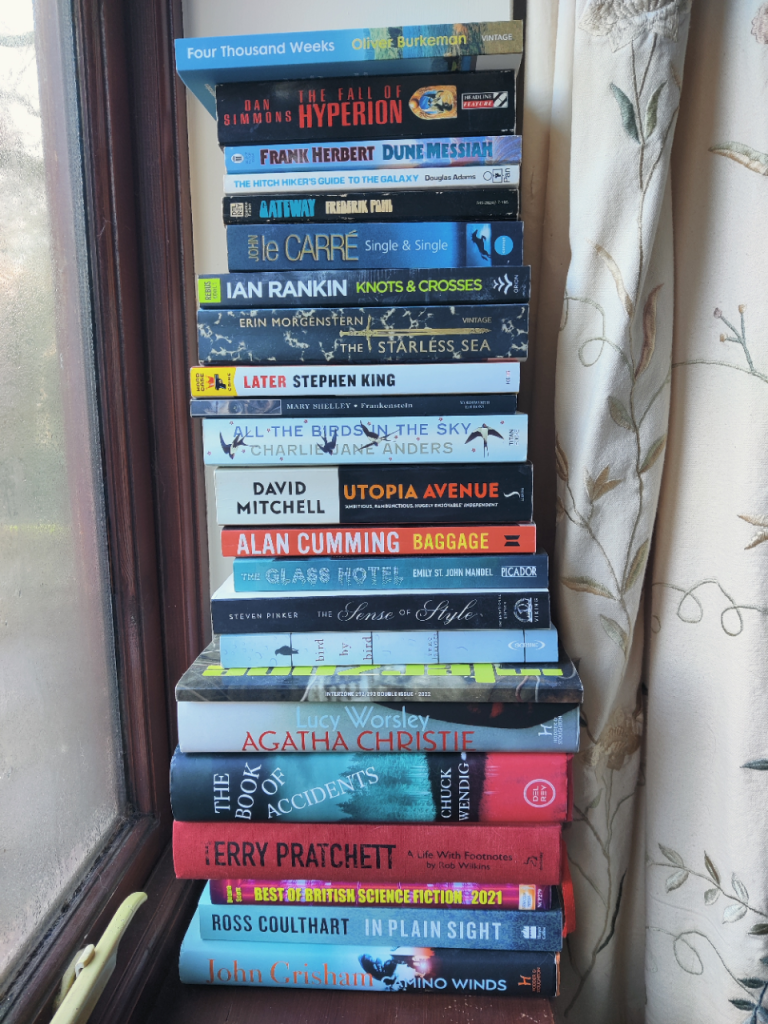
So these are the physical books that I read in 2022. As in previous years, I thought my reading rate had slowed but in actual fact, seeing everything in one place for the first time, it’s about the same as the last two years. (I haven’t counted because I’m not that bothered about keeping score; I’m just judging from the height of the stack in the photos). At a guess, I probably read the same number again in ebook formats – if you include Asimov’s, Analog and Fantasy & Science Fiction every two months, plus a bunch of others on a less regular schedule, in addition to ‘normal’ ebooks. And roughly 12 audio books a year, since I have a monthly Audible subscription. It’s w-a-y fewer than many folk, but that’s fine. I have a limited amount of time for reading while trying to fit everything else in, though I’m always looking for ways to find more.

My favourites amongst this stack? I absolutely loved Emily St John Mandel’s “The Glass Hotel” which I then followed up with the audiobook of “Sea of Tranquility” which was also just perfect. Although it wasn’t essential to the story, I loved the echoes of the earlier book which appeared throughout. Plotting, characters, setting – everything just fell into place. If you enjoyed her “Station Eleven” I don’t think you’ll be disappointed with these two.

I also lapped up Lucy Worsley’s biography of Agatha Christie. I was given this as a Christmas present so had the luxury (for me) of reading it relatively quickly over the holiday period. I’m itching to go back and re-read some Agatha Christie again now.

The biography of Terry Pratchett was equally engrossing although inevitably left me feeling sad at the great loss of Terry’s passing. Rob Wilkins has done a superb job on this and it feels a fitting memorial to Terry’s work and life.

Finally, I found time to return to a familiar comfort read – the Hyperion saga. Of all the fiction I reread (which is generally very little because there are so many new books demanding my attention) the Hyperion saga is the one I must have read the most. For me, it embodies everything I want out of a science fiction novel and the books still feel fresh every time I read them.

Analog blog-post and a Q&A with me!

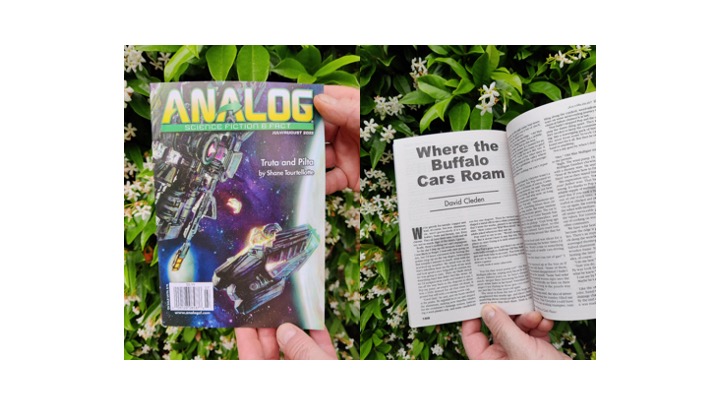
So alongside my story “Where the Buffalo Cars Roam” about make-do-and-mend survival in a post-apocalypse world where a few autonomous vehicles still run wild – you have read it, right? – the Analog blog site (aka the Astounding Analog Companion) have very kindly published a blog I wrote and a Q&A session with me.

The blog-post revisits the thorny old debate about which is better: physical books or e-books? Of course, what’s best for an individual partly depends on what you’re hoping to gain from the reading experience, your circumstances and surroundings, and in no small part, personal preference. There is no right or wrong answer – but I had fun looking at some of the pros and cons and exploring my own feelings on the matter.

The Q&A explores the many influences (science fictional and otherwise) on my reading down through the years, my author heroes and some of the things which triggered the writing of “Where the Buffalo Cars Roam.” It was a fun exercise answering Analog’s questions and I’m absolutely thrilled to be featured on the Analog Companion website. Who would ever have thought it!

You can check them both out here:

Published in Analog!

“Where the Buffalo Cars Roam” in the July/August 2022 issue of Analog

I’m thrilled to have had my first ever story published in Analog Science Fiction & Fact magazine. It’s called “Where the Buffalo Cars Roam” and is set in a post-apocalyptic future where small enclaves of people live a rural, make-do-and-mend kind of existence. It’s a long way from the technological wonders of times gone by. The oldest generation can still remember how it used to be, back when there were things like semi-sentient, autonomous, solar-powered vehicles driving people around. While much of that society has crumbled and decayed, it’s rumoured a few autonomous vehicles have survived and run wild along the deserted roads. Joel remembers his father’s stories about what such cars were capable of: dangerous, feral machines, not afraid to kill. In trying to live up to his father’s memory as a talented engineer and practical handyman, Joel is forced to confront his fears once more in order to survive.

The story has been out for a couple of weeks so I’m also delighted to have received such positive feedback on it from various readers and reviewers. I think it’s always quite difficult for authors to be impartial about a story’s qualities (or lack thereof) so feedback from others is so vital.

I’ve been reading Analog for more years than I care to remember. Right from my earliest days of dreaming of being a writer, I’ve always played a particular what-if game. What if one day I managed to get a story published in Analog – a magazine that has published so many of my favourite authors over the years – and now I have!

I’m hoping this will be the start of further publications in Analog and other high prestige venues but that rather depends on me getting off my backside and putting pen to paper (or fingers to keyboard). But first I’m going to take a brief moment to enjoy this feeling – because I think that’s what life’s all about after all, making the most of the here and now.

This never happens!

Any of you who are short story writers will be familiar with the agony (and occasional ecstasy) of the submission process. The gap between sending a finished story out into the big wide world and hearing back from an editor can be as short as a day or two (though that’s rare) up to many months or years even (also, thankfully, rare). The longest time I had a piece out on submission before an acceptance was a little over a year.

That’s just a fact of life for short story submissions. Many of the publishing venues are run by enthusiasts who devote a considerable amount of their spare time to publishing their ’zine and it would be churlish of authors to expect fast turn-around times (but all credit to those that do manage it). Even the professional magazines work to busy schedules and have limited budgets and overworked staff which means it can take months to work through the submission slush pile.

Of course, if the submission outcome is an acceptance then the wait, no matter how many weeks, months or years, disappears in the unbridled joy of the moment. An acceptance! Yay! Though sadly, more often than not, the only result of all that waiting is a polite rejection.

So you’ll understand my amazement and disbelief at what happened last week. I began a writing session by sending off a previously completed story to a prime market. That job done, I settled down with my current work-in-progress. About 45 minutes later an email landed in my inbox from the publication I’d just submitted to. Of course, receiving a submission acknowledgement is pretty standard but when I opened it up… My story had been accepted for publication!

This was a pro market, too! (Probably best I don’t say which one at this time as the editor won’t thank me for setting expectations that may be difficult to meet on a regular basis!) The editor wrote me a very nice message saying that he happened to see the story land in the submission queue, read it and felt it clicked immediately and so sent the acceptance.

I’ve been doing this long enough to know just how rare an occurrence this is. From submission to return of a signed contract in less than an hour! This never happens! (And the fact that it’s a pro market that I respect highly is just icing on the cake. Something like this has never happened before and I doubt it will happen again – just a very fortunate set of circumstances. But all the same, I’m very happy that it did.

Going to Cymera 2022!

I’m really pleased to be heading off to the Camera 2022 event in Edinburgh next week, billed as Scotland’s festival of science fiction, fantasy and horror writing. It’s taking place over the Jubilee weekend, 3rd to 5th June.

This is only the second full-blown SF convention/festival I’ve attended – the other being Worldcon, Dublin in 2019 so although this is on a much smaller scale, it’s no less exciting and there looks to be a packed programme of events. It’s also only the second time I’ve visited Edinburgh, the last being some mumblety-mumble years ago when I was definitely a lot younger and had more hair. So it’s a double cause for anticipatory celebration.

We’re heading up from London by train which is another fun part of the trip I’m looking forward to. Basically after two plus years (more or less) of stay-at-home misery, this feels like an excellent opportunity for some travel and adventures, plus the chance to meet some favourite authors and sit in on some great panel discussions.